
Locked at the brand. Edited by the user. Audited end-to-end.
Design Assistant locks every brand-critical element — logos, colours, fonts, layout — and lets non-designers edit only the fields you've configured. Every action logged. Every output audit-trailed.
On-brand output — without giving away brand control.
The failure mode
The failure mode every distributed brand shares
Across NFPs, federations, multi-school education bodies, and franchise networks, the same pattern shows up.
Many people publish in your brand
Hiring managers, regional fundraisers, volunteer coordinators, branch managers, school administrators, franchisees, partnership leads — each one creating public-facing content under your logo.
Almost none of them are designers
They reach for whatever they know — PowerPoint, Word, Canva, the last document a colleague sent them. Brand drift is the default.
Your central design team can't be the gate
Two to five people in central comms cannot physically design or review hundreds of assets a month. The bottleneck either delays the campaign or gets bypassed entirely.
“Off-brand” doesn't look off-brand to the person making it
Wrong logo lock-up, wrong shade of the primary colour, wrong font substitution, wrong margin — the person creating the asset thinks it looks fine. The brand team finds out when it's already published.
When a franchisor, trustee, Charity Commission audit, or board review asks “show me what was published in your brand this quarter — and prove it was approved” — most organisations have no systematic answer.
Design Assistant is that answer.
How it works
How Design Assistant actually works
Design Assistant isn't a design tool with extra rules. It's a governance layer that makes the design decision before the user starts editing — and then logs everything the user does.
Four enforcement levels, set by your admin
Locked brand elements
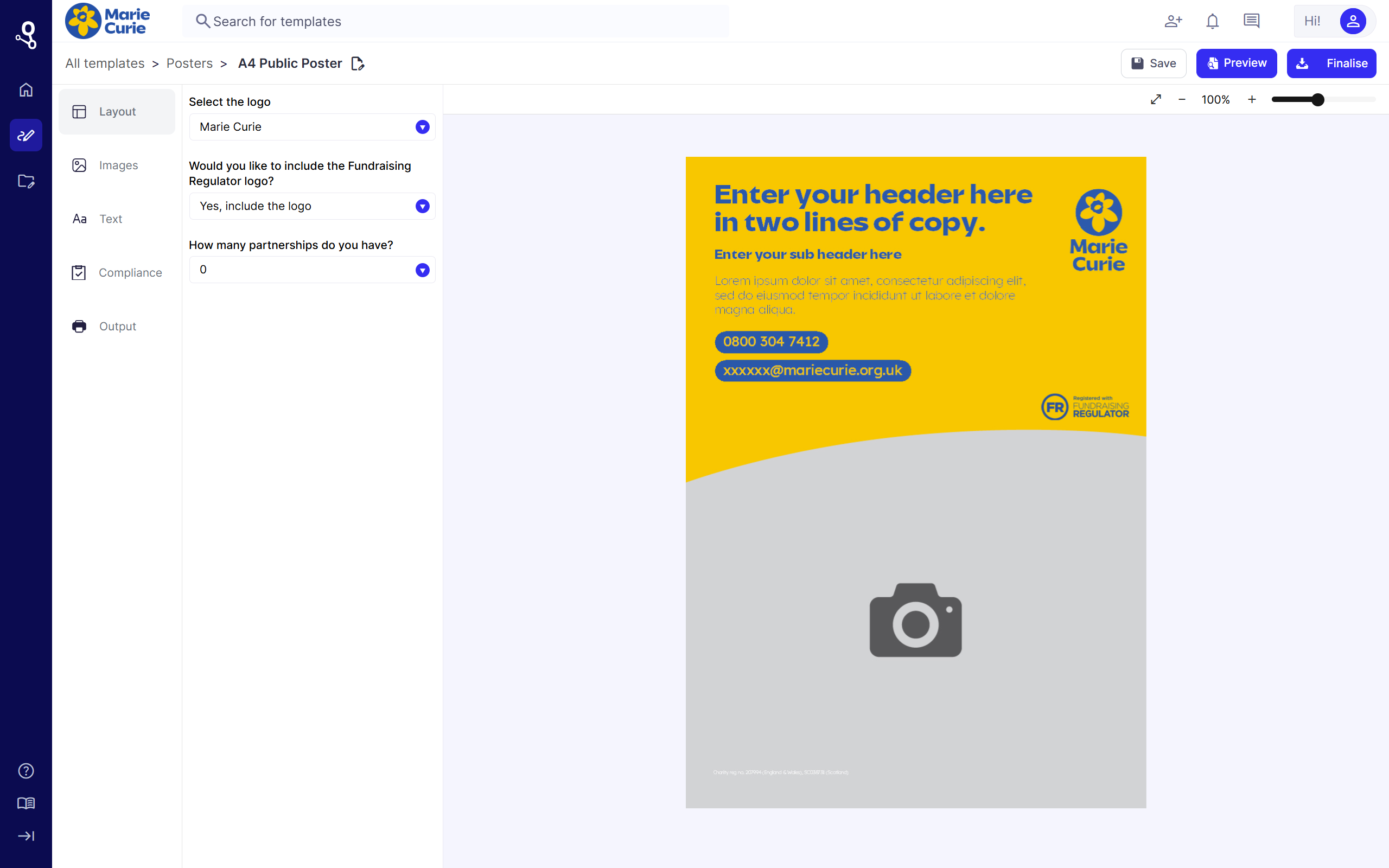
Logos, colour palette, fonts, master layout, legal text — non-editable. Users cannot break these, intentionally or accidentally. No “free design canvas” exists for these elements.
Field-level constraints
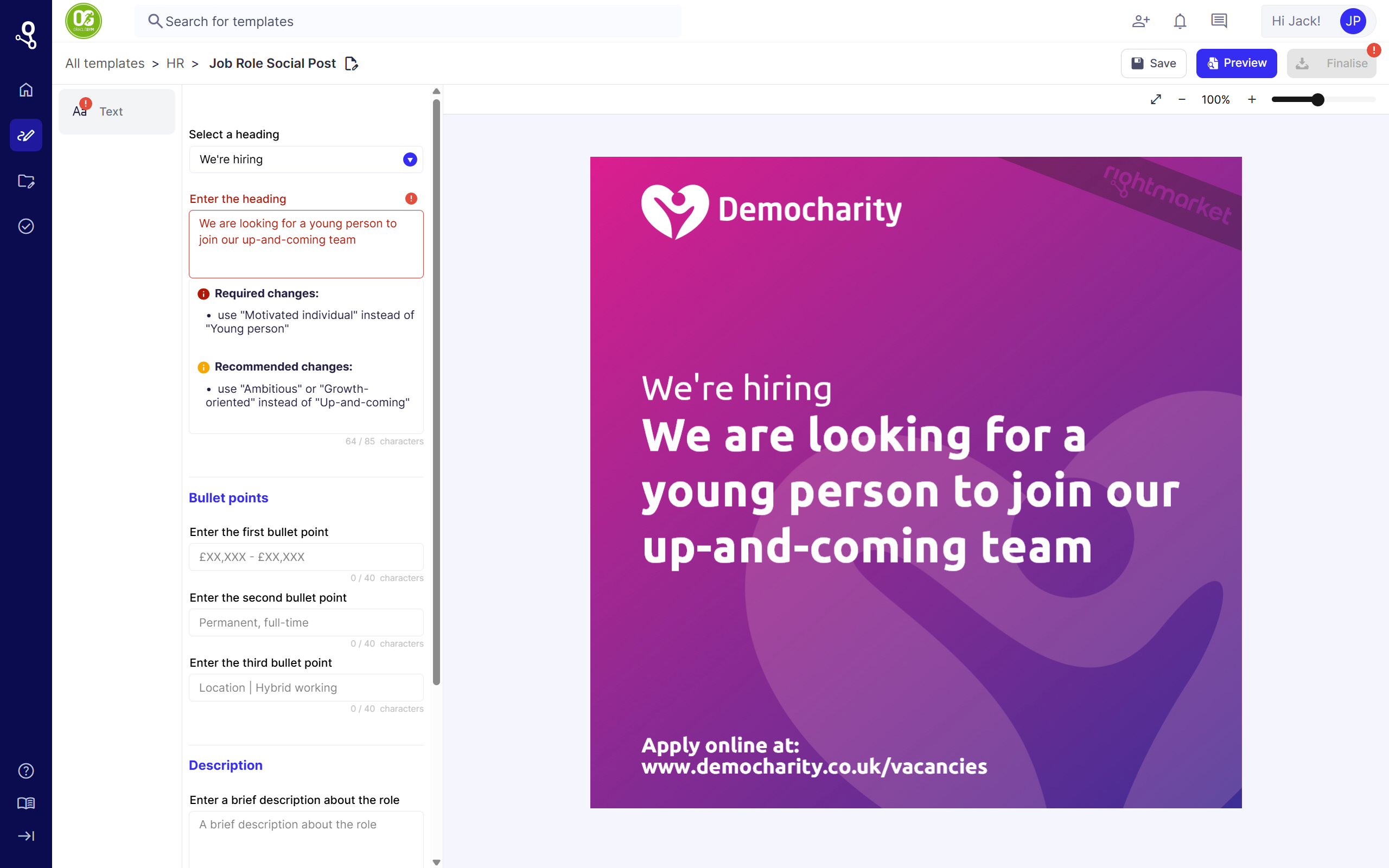
Character limits, word counts, validation rules, field types (text, URL, date, dropdown, checkbox). Users edit inside the constraints you set; the constraints are enforced at input.
Dynamic field logic
Conditional fields that appear or hide based on user selections. Cascading dropdowns from your Content Central database. Mindset-specific messaging that routes to the right approved copy.
Approval workflows
Multi-level approval routing (sequential or parallel) by template, by user, or by group. Brand → legal → compliance, or local → regional → HQ. Every approval, decline, and resubmission logged.
Educational feedback, plus an audit trail by default
When a user hits a character limit, a locked field, or a validation rule, they see the rule and the rationale — not just an error. They learn the brand standards while they work. And every design records:
- Who created it — and from what template
- Which fields they edited and exactly what changed
- Who approved it, and when it went live
- Where the asset was distributed
- Exportable for franchisors, trustees, or internal reviews
Configured once. Enforced across every user, every template, every workflow.
In the field
Where Design Assistant earns its keep
Design Assistant is the same product in every use case. The configuration changes; the governance layer doesn't.
Franchisor liability for network-wide brand misuse
Who feels it
Franchisor HQ Brand Manager, Head of Network Operations, CEO
What it controls
Logo lock-up on every unit's local marketing, approved promotion windows, regulator-mandated wording (claims, disclaimers, pricing transparency), regional adaptation within network standards.
Why it matters
A franchisor is liable for the content published across its network. Unit-level brand drift compounds into network-wide reputational risk.
Brand governance for content nobody from central designed
Who feels it
Head of Brand, Head of Fundraising, Director of Communications
What it controls
Event poster templates, supporter fundraising packs, regional appeals, volunteer-led campaign assets — each one carrying the right logo, right disclaimers, right charity registration number.
Why it matters
Supporter-created and regional-team-created content is the largest unmanaged surface in most charities. One unauthorised use triggers a Fundraising Regulator complaint.
Consistency across schools, faculties, and student-facing teams
Who feels it
Director of Marketing, Head of Brand, Head of Student Recruitment
What it controls
Course marketing across faculties, school-level open-day collateral, regulator-mandated compliance text (OfS, accreditation bodies), accessible PDF output settings.
Why it matters
OfS expects evidence of consistent recruitment marketing. Faculty-by-faculty drift undermines the institution's compliance position.
Member-led publishing under a shared brand
Who feels it
Federation Communications Lead, Brand Manager, Network Director
What it controls
Member organisation outputs that carry the federation brand, regulator-mandated wording per member's regulated scope, shared campaign rollouts.
Why it matters
A federation's reputation is the average of its members' worst output. One unit's off-brand asset becomes the network's problem.
Scale without losing control
Who feels it
Head of Brand, Brand Manager, Creative Lead
What it controls
Templates for every department that publishes — HR, fundraising, programmes, retail, volunteering, comms — each scoped to that department's needs.
Why it matters
Two to five people in central brand can govern hundreds of users — without becoming the bottleneck or being routed around.
Co-branded partnership assets
Who feels it
Head of Corporate Fundraising, Director of Partnerships
What it controls
Partnership co-branded assets where your logo sits next to a corporate partner's. Lock-up rules, partnership wording, financial disclosure language.
Why it matters
Co-branded assets are reputation-shared assets. A misuse by a corporate partner damages both brands.
The full picture
How Design Assistant fits with the rest of the platform
Design Assistant is the governance layer. The rest of RightMarket makes the workflow auditable end-to-end.
Tone of Voice Assistant
Screens the words your users type inside the templates Design Assistant locks. Every text field, every language rule, enforced in real time.
Content Central
Pre-approved content blocks and cascading databases that auto-populate locked fields. Users compose from approved options; Design Assistant enforces the structure around them.
Image Security
Every image used inside a Design Assistant template is consent-verified before publish. Expired consent blocks the design.
Compliance Automation
Full audit trail. Who created, who approved, what changed, what got flagged, when it published, where it was distributed. Exportable per asset, template, user, or network unit.
Right fit?
Who this is for
Design Assistant is built for organisations where:
- Many non-designers publish in your brand — and a central design team can't physically be the gate
- A central function is accountable for brand consistency — but does not draft every asset
- A documented audit trail is non-negotiable — Charity Commission, OfS, CQC, FCA, franchisor liability, trustee oversight, network governance
- A single off-brand asset is materially expensive — financially, reputationally, or both
If your designers want a faster InDesign or a free Canva-like canvas, RightMarket isn't the right fit. Design Assistant is the governance layer that lets non-designers publish without breaking your brand — and the audit trail that proves they didn't.
What to do next
See Design Assistant in action
Book a demo and we'll talk through your specific governance surface — and show you exactly how Design Assistant locks your brand while letting non-designers publish.